Guest Experience Lead: The Role, Skills, Pay, and KPIs
Understand what a Guest Experience Lead does, how the title differs by employer, and which skills, tools, KPIs, and qualifications matter.

A guest experience lead owns or coordinates continuous improvement across the full guest journey, from reservation to post-stay engagement. The verdict: the title alone does not establish seniority, compensation, or authority. Evaluate the reporting line, decision rights, systems access, and measurable accountability before treating the position as either a leadership role or a senior service position.
Pas le temps de lire ?
- A Guest Experience Lead coordinates improvement across booking, arrival, the stay, departure, and post-stay follow-up—not only complaint handling.
- Lead is not a standardized seniority level; reporting lines, direct reports, decision rights, and recovery authority reveal the actual position.
- The role combines personalization, service recovery, feedback analysis, digital engagement, and cross-department execution.
- No single salary figure is reliable without location, property scale, schedule, benefits, and confirmation of whether the job manages people.
The Title Does Not Define the Authority
In the US hospitality industry, “Lead” and “Manager” are not standardized levels. A Guest Experience Lead may be an experienced individual contributor, a shift leader, a supervisor with several direct reports, or the functional head of guest experience. A Guest Experience Manager can carry the same range of responsibilities.
This ambiguity makes the guest experience lead job description more useful than the title. Before judging seniority, candidates and employers should clarify five points:
- Who does the role report to?
- Does it have direct reports?
- Does it own a departmental budget?
- What compensation or service recovery can it authorize?
- Can it change procedures across hotel departments, or only recommend changes?
A true leadership position needs authority proportionate to its KPIs. Holding someone responsible for guest satisfaction, online reputation, or recurring service failures without giving that person cross-functional decision rights creates accountability without control.
The strongest role design defines where the Lead can act independently, when escalation is required, and which department heads must participate in corrective action.
Guest Experience, Guest Relations, and Customer Service Solve Different Problems
Guest experience is proactive and cross-functional. It identifies friction before, during, and after the stay, then coordinates operational changes across reservations, reception, housekeeping, food and beverage, amenities, and digital channels.
Customer service and guest relations are often more reactive. A customer service manager may focus on inquiries and case resolution. A guest relations manager may handle VIP recognition, complaints, and face-to-face engagement. The guest experience manager should connect those interactions to the broader operating system rather than treating each complaint as an isolated event.
| Role orientation | Primary problem | Typical scope | Success signal |
|---|---|---|---|
| Guest experience | Friction across the guest journey | Cross-department processes, personalization, feedback, digital touchpoints | Higher satisfaction and fewer recurring defects |
| Guest relations | Individual guest needs and recovery | In-stay engagement, VIP handling, complaint resolution | Effective recovery and stronger guest sentiment |
| Customer service | Questions, requests, and reported problems | Service channels and case management | Accurate, timely resolution |
| Front office | Arrival, departure, and account execution | Reception, check-in, room assignment, billing | Efficient and accurate transactions |
In some properties, one person performs all four functions. In larger hotels, they may be separate teams with shared workflows.
Context also matters because titles such as GEM, customer experience manager, and customer service manager appear outside hotel management. A retail or entertainment role may use similar language without involving room operations, reservation systems, housekeeping coordination, or overnight service. Candidates should confirm that the position actually operates within a hotel or accommodation environment.
One Role Across the Entire Guest Journey
The Lead’s value comes from continuity. Information captured before arrival should improve room preparation, in-stay communication, and future visits. Effective hotel guest relations therefore begins before the guest reaches reception and continues after checkout.
- Pre-arrival: Review reservation details, guest profiles, previous feedback, travel purpose, accessibility requirements, dietary preferences, family needs, and special occasions. Coordinate cots, accessible room preparation, vegetarian options, birthday amenities, honeymoon champagne, or other approved arrangements. Confirm that promises made through reservation portals or direct channels can be delivered.
- Arrival and in-stay: Ensure the front office has current information and that relevant hotel departments know their responsibilities. Position guest-experience staff at high-value touchpoints, including reception or food and beverage entrances, when operating conditions justify it. Provide information matched to the stay, such as Wi-Fi details for a business traveler or spa hours and activity schedules for a leisure guest.
- Active monitoring: Maintain proactive contact without creating unnecessary interruption. Track requests, confirm completion, conduct concise satisfaction checks, and intervene when a delayed or incomplete service threatens the stay.
- Post-stay: Send short surveys, monitor review sites and social media, respond within brand guidelines, and follow up on unresolved cases. Record verified preferences and remove inaccurate or unnecessary information from guest profiles.
Personalization is not simply adding amenities. It is the reliable execution of relevant preferences across departments. A welcome item loses value if the room type is wrong, an accessible setup is incomplete, or the guest must repeat the same request at every touchpoint.

The Daily Operating Cadence
A realistic workday combines planned reviews with live operational control. The sequence changes by property, but the core cadence usually includes:
- Review arrivals, departures, VIP designations, guest profiles, special requirements, group activity, and open service cases.
- Inspect unresolved complaints and confirm ownership before the operations briefing.
- Attend or lead a briefing with the front office, housekeeping, food and beverage, engineering, security, and other relevant departments.
- Monitor guest service platforms, messaging channels, reception feedback, social media, and urgent requests.
- Authorize recovery within defined limits or escalate financial, safety, legal, or brand-sensitive cases.
- Verify that requests were completed, not merely assigned.
- Document accurate preferences and relevant recovery history in the CRM.
- Analyze emerging customer feedback for patterns requiring immediate action.
- Close the shift with clear handoffs, named owners, deadlines, and escalation status.
The position is rarely confined to standard office hours. Evening, weekend, holiday, event-period, and peak-occupancy coverage may be part of the role because guest-impacting failures do not follow an administrative schedule.
That schedule materially affects the guest experience salary decision. Compensation should reflect coverage expectations, on-call duties, recovery authority, team supervision, and the operational consequences of being accountable during high-demand periods.
Feedback Must Become an Operating Change
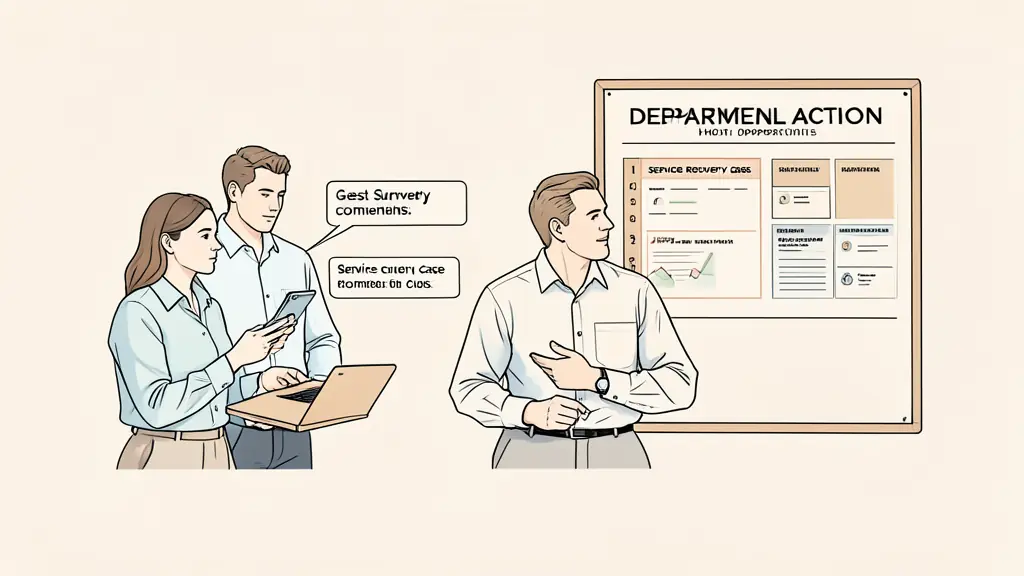
Collecting comments is not feedback management. The operating value appears only when customer feedback changes a process, training standard, system configuration, or accountability mechanism.
A disciplined workflow has seven stages:
- Collect comments from conversations, reception comment boxes, internal surveys, email surveys, guest messages, reservation portals, review sites, forums, social media, and hotel websites.
- Categorize each issue by journey stage, department, severity, root-cause hypothesis, and recovery status.
- Separate isolated preferences from recurring defects.
- Assign an accountable owner and deadline.
- Validate the corrective action through inspection, system evidence, or subsequent guest feedback.
- Monitor whether the issue recurs.
- Recognize successful service practices worth standardizing.
Complaints and negative reviews require an initial acknowledgment, fact gathering, resolution within authority limits, and escalation when safety, discrimination, privacy, payment, or material compensation is involved. Closing the individual case is not enough. The Lead must ask what allowed the failure to occur and whether another guest could encounter the same defect.
Useful KPIs include:
- Guest-satisfaction scores, tracked by segment, channel, property area, or journey stage where sample quality permits.
- Review sentiment and the frequency of recurring themes.
- Complaint-resolution time, measured from receipt to verified closure.
- Repeat-stay behavior and guest loyalty engagement.
- Loyalty enrollment quality, not enrollment volume alone.
- Recurring-defect rate after corrective action.
- Percentage of cases reopened because the first resolution was incomplete.
- Cross-department action completion by the agreed deadline.
No universal benchmark applies to every property, segment, or survey method. Trend direction, response quality, and comparison with the property’s own operating baseline are more defensible than an isolated score.
For candidates pursuing a broader hospitality career path, the ability to convert qualitative comments into verified operational improvement is stronger evidence than simply reporting a high volume of guest interactions.
The Technology Stack and Its Boundaries
The Lead does not need to administer every platform, but must understand how information moves across the stack and where errors can damage the experience.
- Property-management and reservation systems: Review stay details, room status, rate or package inclusions, notes, and operational commitments. Pricing decisions remain aligned with revenue management authority.
- Customer relationship management software: Maintain useful guest profiles, verified preferences, consent status, and interaction history. CRM records should improve execution across future stays.
- Guest service platforms: Assign requests, track ownership, monitor response time, and confirm completion.
- Messaging and social media: Answer questions, detect dissatisfaction, and route cases without exposing personal information.
- Review sites and survey platforms: Identify sentiment, recurring defects, and successful service elements.
- Hotel websites and mobile applications: Check whether service information is accurate, accessible, and consistent with on-property delivery.
- Digital check-in and digital room keys: Monitor adoption and failure points while preserving a workable alternative for guests who cannot or do not want to use them.
- Electronic locks and access control: Coordinate room-access issues with security, engineering, and the front office. Access credentials should never be handled casually.
The same discipline applies when the guest journey touches connected amenities, safes, minibars, or energy-saving devices. The Lead coordinates the experience and escalation path rather than bypassing technical or security controls.
Personalization has boundaries. Collect only information that has a defined operational purpose, restrict access by role, record consent where required, and correct inaccurate preferences. Accessibility cannot depend exclusively on a mobile interface. Sensitive details should not be placed in free-text notes merely because they might be useful later.
Useful personalization reduces effort for the guest. Intrusive personalization reveals that the hotel collected more data than the guest expected or used it outside the context in which it was provided.
Skills That Separate Coordination From Leadership
Competency matters only when it produces an operating result.
- Concise communication: Creates clean shift handoffs and prevents requests from being lost between hotel departments.
- Empathy and cultural sensitivity: Improves interpretation of guest needs without relying on assumptions about nationality, family status, disability, or dietary practice.
- Composure: Supports proportionate service recovery when a guest is dissatisfied or operations are under pressure.
- Attention to detail: Ensures that preferences, amenities, room arrangements, and special-occasion commitments are executed accurately.
- Leadership: Establishes cross-department accountability even when the Lead does not directly manage every person involved.
- Adaptability: Preserves service standards during peak seasons, events, disruptions, and rapid changes in occupancy.
- Digital fluency: Enables effective monitoring of the CRM, reservation systems, guest service platforms, surveys, and public channels.
- Analytical ability: Converts unstructured comments into patterns, priorities, and testable corrective actions.
- Business acumen: Balances guest value, recovery cost, brand standards, labor capacity, and long-term loyalty.
Coordination moves information. Leadership ensures that someone acts on it, validates the result, and prevents recurrence. That distinction should be visible in both the role design and the candidate’s evidence.
Relevant Qualifications Without Credential Inflation
A hospitality management degree, hotel administration qualification, tourism degree, or business administration background may provide useful commercial and operational foundations. These credentials are typically relevant, but they are not universally mandatory.
An MBA with a hospitality concentration is more applicable to progression into portfolio leadership, corporate strategy, or senior operations than to most entry-level Lead positions. Requiring one without corresponding authority can unnecessarily restrict the candidate pool.
Credible preparation can come from front-office supervision, guest relations, customer service, concierge work, event operations, internships, or direct ownership of service recovery. The stronger candidate can show outcomes: a recurring defect eliminated, response time improved, guest satisfaction strengthened, or a cross-functional process adopted.
Employers should test judgment, systems fluency, and implementation discipline rather than using education as a substitute for evidence.
Decode the Job Posting Before Comparing Compensation
A compensation comparison is valid only after the operating scope has been decoded. Use this US-market checklist:
- Reporting line: Does the role report to a front office manager, rooms director, general manager, director of guest experience, or corporate leader?
- Property context: What are the property type, service level, room count, outlet complexity, and operating hours?
- Employment environment: Is the property unionized, and how does that affect task allocation or supervisory responsibilities?
- People management: Are there direct reports, hiring duties, scheduling responsibility, coaching expectations, or disciplinary authority?
- Coverage: Are evenings, weekends, holidays, overnight escalation, or event periods required?
- Physical demands: Does the position require extended standing, movement across a large property, or operational assistance at service points?
- Technology: Which CRM, reservation systems, mobile applications, survey tools, and guest-service channels must the employee operate?
- Recovery authority: What can the Lead approve without escalation, and does that include financial compensation?
- Performance measures: Is the role accountable for satisfaction, online reputation, resolution time, loyalty, repeat stays, or defect reduction?
- Managerial scope: Does “Lead” mean senior individual contributor, shift supervisor, or people manager?
- Total compensation: Are bonuses, benefits, paid leave, meals, parking, travel requirements, or other material terms included?
The available evidence does not support a defensible single US salary figure for this title. Compensation varies by location, experience, employer, property scale, market demand, schedule, benefits, bonus eligibility, and actual managerial scope.
A posting that demands portfolio-level analysis, unrestricted availability, team leadership, and cross-department accountability should not be compared with a reception-based individual contributor role merely because both use “Guest Experience Lead.”
Build the Application Around Evidence of Guest Impact
The route into the position is operational. Gain guest-facing experience, master the systems that carry guest information, own a measurable service-recovery or feedback initiative, and target employers whose authority level matches your readiness.
Resume language should connect an action to an operating result. Relevant keywords include guest journey, guest satisfaction, service recovery, customer feedback, online reputation, personalization, CRM, digital check-in, cross-functional coordination, loyalty engagement, and process improvement.
Use achievement structures such as:
- Identified a recurring service defect, coordinated corrective action across named departments, and tracked recurrence after implementation.
- Redesigned a complaint-routing process and reduced response or closure time by a documented amount.
- Improved review sentiment around a specific property touchpoint through training, process changes, or clearer ownership.
- Increased repeat stays or guest loyalty engagement through a defined follow-up or recognition process.
- Standardized guest-profile documentation to improve preference accuracy and reduce repeated requests.
- Coordinated front office, housekeeping, and food and beverage execution for accessibility, dietary, family, or special-occasion requirements.
Do not invent percentages or imply causation that the available data cannot prove. If exact results are confidential, describe the baseline problem, intervention, measurement method, and verified direction of change.
Prepare four interview cases:
- A service recovery in which authority limits affected the resolution.
- A recurring defect that required root-cause analysis rather than repeated compensation.
- A peak-demand period in which several urgent guest needs competed for limited resources.
- A personalization decision that balanced usefulness, consent, privacy, and operational feasibility.
Before applying, complete a final two-part check.
Job-posting evaluation
- Can you identify the reporting line and managerial level?
- Are direct reports, schedules, recovery limits, systems, and KPIs explicit?
- Does compensation reflect the property, coverage, and decision rights?
- Is the role empowered to influence the departments responsible for its results?
- Does the employer distinguish guest experience leadership from complaint handling?
Application readiness
- Does the resume show measurable guest impact rather than a list of duties?
- Can you explain how feedback became an operating change?
- Can you demonstrate competence with relevant systems and digital channels?
- Do your examples show judgment under pressure and cross-functional leadership?
- Can you discuss personalization without ignoring privacy and accessibility?
Strong performance can lead to director of guest experience, regional manager, regional operations, corporate strategy, training, brand management, vice president of operations, or consulting roles. Progression depends less on the word “Lead” than on demonstrated control of increasingly complex guest, operational, and commercial outcomes.
Envie d'aller plus loin ?
Laisse ton email, on te prévient dès qu'un nouvel article sort.