What Does Hospitality Mean to You: The Framework for a High-Impact Interview Answer
To answer 'What does hospitality mean to you', start by auditing the interviewer's intent, build a behavioral philosophy, then validate it with quantified evidence.

Executive verdict: When an interviewer asks « what does hospitality mean to you? », they are not seeking a dictionary definition or a sentimental story, but a professional service philosophy that can be scaled, measured, and replicated to drive guest loyalty and asset profitability. The real starting point is the alignment of human empathy with operational excellence. This guide provides the framework to transform a vague question into a strategic demonstration of your value.
Audit the Interviewer’s Intent Before Crafting Your Answer
The question is a test of professional judgment and alignment with brand standards, not a personality test. An executive hiring manager is evaluating your ability to distinguish between a transactional exchange and a relationship-driven experience. They need to know if you can maintain a high-standard guest journey without compromising the property’s bottom line.
The ‘Service vs. Hospitality’ Distinction
Understanding the nuance between hospitality vs customer service is the first step to a high-impact answer. Customer service is transactional: it is the act of providing a room, a meal, or a check-in process efficiently. Hospitality is the emotional layer added to that transaction. While service is the « what » (the delivery of the product), hospitality is the « how » (the feeling of being welcomed, valued, and understood).
The Business Logic Behind the Question
From a management perspective, hospitality is a tool for revenue growth. High-impact hospitality creates an emotional connection that transforms a one-time visitor into a loyal advocate. This is where the business logic resides: 86% of adults in the United States are stated to be willing to pay extra for a better customer experience. By mastering this, you directly influence Guest Experience Lead KPIs, such as increasing the lifetime value of a guest through repeat visits.
Build Your Personal Service Philosophy
A professional definition must move beyond « being nice » to a structured approach. Your philosophy should be rooted in the concepts of hospes (the guest) and hospitalitas (the act of hosting), framing hospitality as a reciprocal relationship where the host provides security, comfort, and recognition.
Defining Your Core Values
To avoid generic responses during hospitality interview questions, build your answer around three operational pillars:
- Anticipation: Identifying unspoken needs before the guest expresses them.
- Personalization: Using data and observation to tailor the experience to the individual.
- Ownership: Taking full accountability for the guest journey, ensuring no touchpoint is neglected.
Connecting Values to Observable Behaviors
Values are irrelevant if they cannot be measured. Anticipation manifests as a pre-arrival check of CRM preference records to prepare a room for a guest’s specific allergy. Personalization is seen when a front-line service agent remembers a guest’s preferred drink from a previous stay. Ownership is demonstrated through a rigorous service recovery process where a mistake is acknowledged and resolved before the guest departs.
Engineer Your Evidence Using the STAR Method
A theoretical definition lacks authority without evidence. To move from « I am helpful » to « I am an asset, » you must anchor your service philosophy in a concrete professional victory. The goal is to show that your approach to hospitality produces a measurable business result.
Selecting the Right Professional Example
Choose a scenario that demonstrates complex problem-solving. For example, consider a late-evening arrival where the kitchen has already closed. A generic answer focuses on apologizing; a strategic answer focuses on the solution. The high-impact candidate describes how they coordinated with the F&B team to provide a curated selection of late-night options, turning a potential service failure into a moment of personalized attention.
Quantifying the Impact on Guest Experience
The « Result » phase of the STAR method is where you prove your ROI. Do not simply state the guest was « happy. » Use data or behavioral outcomes. For instance, mention a case where a personalized anniversary gesture led to three repeat visits within two months, or a situation where a seamless event planning and management execution resulted in three corporate event recommendations. This connects the emotional connection to the property’s growth.
Compare Service Frameworks for Different Role Levels
The definition of hospitality evolves as you move up the organizational chart. While a front-line employee focuses on the immediate touchpoint, an executive focuses on the systems that enable those touchpoints to happen consistently across a portfolio.
Operational Execution vs. Strategic Oversight
The shift is from individual performance to organizational culture. For a manager, hospitality means implementing team briefings and service standards to ensure that « above and beyond » service is not a random occurrence, but a scalable system. For an executive, it is about balancing the cost of labor—noting that hotels paid approximately $125.8 billion in wages in 2024—with the need to maintain luxury standards.
The following table illustrates how the application of hospitality differs across hospitality career pathways:
| Role Level | Primary Focus | Key Tool | Success Metric |
|---|---|---|---|
| Entry-Level | Individual Touchpoint | Active Listening | Guest Satisfaction Score |
| Management | Team Consistency | Service Standards | Staff Retention / RevPAR |
| Executive | Asset Scalability | PMS / CRM Integration | guest experience ROI |
This progression shows that as seniority increases, the « human » element of hospitality is managed through technology and systems to ensure reliability.
Validate Your Answer for Maximum Executive Impact
The final risk in an interview is sounding over-promising or unrealistic. Extreme hospitality that ignores operational boundaries leads to staff burnout and margin erosion. An executive answer acknowledges the tension between genuine care and commercial objectives.
Avoiding the ‘Generic Trap’
Avoid phrases like « I love making people happy. » Instead, use the STAR method hospitality framework to describe how you used hospitality technology, such as a POS or PMS, to streamline a process that freed up more time for guest interaction. This shows you value efficiency as much as empathy.
Aligning with Property ROI
Your answer must reflect the property’s positioning. A boutique hotel requires high-touch, personalized attention, while a large-scale resort requires scalable, consistent service quality. Demonstrate that you can calibrate your service delivery to match the brand’s target demographic and price point, ensuring that every « extra » effort contributes to the overall asset value.
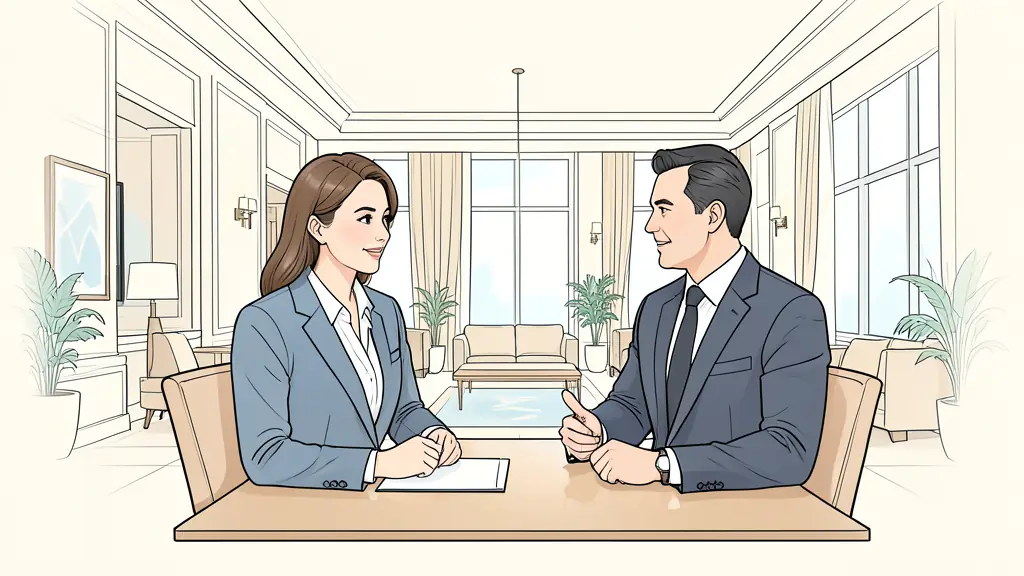
Decide whether to present yourself as a high-empathy service provider or a strategic hospitality leader. The latter is more valuable to an owner: someone who views emotional connection not as a sentiment, but as a precision tool for operational excellence and revenue growth.
Audit your chosen example one last time: if the result does not lead to loyalty, a recommendation, or a measurable increase in GOPPAR, replace it with a scenario that does.
Envie d'aller plus loin ?
Laisse ton email, on te prévient dès qu'un nouvel article sort.